

In my previous blog post, I explored why replacing an instruments-based approach to assessment with an outcomes-based one can be beneficial for students. I explained what outcomes-based assessment actually is and gave some examples. I imagine some readers might have thought: “This is easier said than done.” So now we’re going to get into the how.
Most contemporary English language teaching curricula have been built around the CEFR’s can-do statements — communicative, real-life tasks that describe what learners can do at each level. These statements are, in essence, the outcomes that drive curriculum design.
Here is an example from Keynote, Second Edition Level 2:

The communicative outcome in this lesson is to talk about a family member.
The CEFR isn’t a curriculum, of course — it’s a framework. So those can-do statements need to be broken down into the building blocks required to actually reach each outcome: the grammar, vocabulary, and language functions they’ll need to put it all together.
In this example, the simple present is one of the key structures that support this outcome. Earlier in the unit, students would have worked on family vocabulary — another stepping stone toward the same goal. The activities in lesson 1B build toward talking about a family member by introducing the simple present in statements and questions and giving students the chance to use it in context.
What does this have to do with outcomes-based assessment? When we adopt this framework, our goal isn’t to assess whether students can conjugate the simple present correctly or recall family vocabulary in isolation. The question we’re really asking is: can they actually have a conversation about a family member, using the right vocabulary and the simple present? Students need to perform a real-world communicative task — not just demonstrate isolated language knowledge.
Once we’re clear on the outcome and the language students need to accomplish it, the evidence we’re looking for becomes obvious. And here’s something that surprises many teachers who are new to outcomes-based assessment: in well-designed coursebooks, that evidence is often right there in the lesson itself — in the consolidation activity.
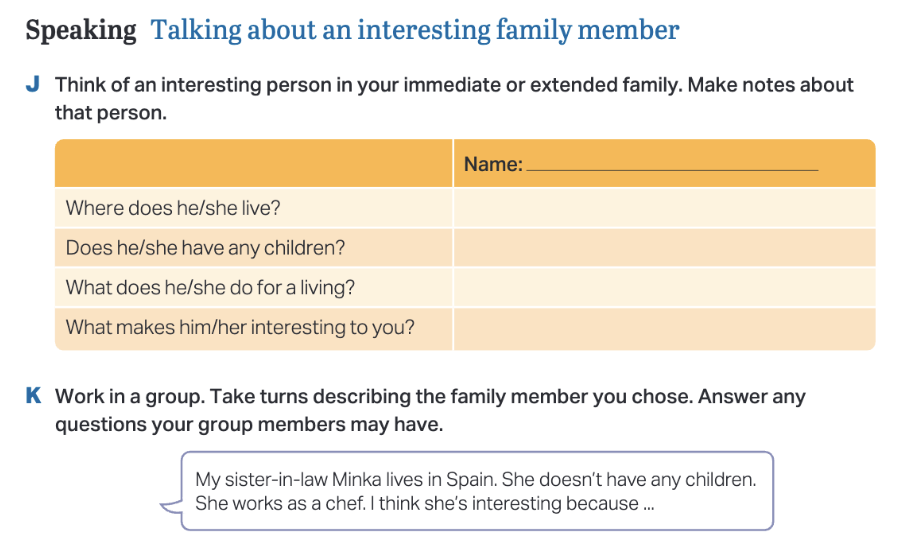
That closing activity is still part of the learning sequence, but it can double as an assessment opportunity. Here’s how:
- Have students do the activity as you normally would. Walk around, monitor them, and decide what to correct on the spot and what to address later through delayed correction.
- Give feedback on how they performed and do some targeted practice on anything that needs more work — question formation, for instance.
- Have students do the task again with a different partner, giving them the chance to act on the feedback they received. This time, share the success criteria — a clear description of what it looks like to have achieved the outcome:
Talk about at least three family members.
Ask at least three questions to your partner.
Use the appropriate family vocabulary.
Use the simple present in statements and questions accurately.
Success criteria make it clear to students what success actually looks like. They also give teachers a concrete roadmap of what to look and listen for.
- Monitor the pairs and give on-the-spot feedback based on the success criteria. Pay close attention to students who have clearly mastered the outcome — this is an important shift in mindset, because we’ve been trained to focus on what’s missing rather than what’s working. Encourage students to reflect on how well they think they’ve met the criteria themselves.
- If time allows, ask a pair you’ve identified as having met all the success criteria to perform their conversation for the rest of the class. This gives everyone a clear, concrete model of what success looks like.
- The next step can take different forms depending on your context — available time, resources, class size, students’ age and profile, cultural background, and so on. Here are some options:
- Let students know you’ll be listening to each pair and taking notes. Invite those who feel ready to go first while others continue practicing.
- Assign an independent activity for students to work on while they wait their turn.
- Have pairs present their conversations to the whole class.
- Ask students to record their conversations in audio or video and post them to your class LMS or communication platform.
- As you listen, use a simple grid with the outcome and students’ names to record whether each student has:
A – Successfully achieved the outcome.
B – Almost successfully achieved the outcome.
C – Needs more practice to achieve the outcome.
D – Not yet provided evidence. (Either did not perform the task or provided too little to assess.)
The sequence above is an example of more than just outcomes-based assessment. It also illustrates assessment AS learning — where the line between learning and being assessed becomes intentionally blurred. It shows how we can make learning visible, particularly when students record their conversations, creating an artifact that captures their learning alongside clear, shared success criteria. And it’s a strong example of performance assessment: students showing what they can do with the language, rather than what they know about it.
Now that we’ve walked through the steps, how confident do you feel about trying this out in your class?
What barriers might you face in your teaching context — and what could you do to overcome them?
Want more tips and real‑world insights from ELT professionals? Subscribe to our global newsletter and stay connected with educators around the world.