
My first job as a teacher in the early nineties was to teach university-age students English and train them in the skills they would need for their future jobs. In 1993, those skills were narrowly defined as communication skills. Since then, I have seen the definitions of the skillset broaden to a range of titles: life skills, soft skills, 21st century skills, employability skills, career skills, workplace-ready skills (and you might know some others). For the educator, this variety of titles hasn’t always been helpful when it comes to knowing what to teach. Instead, the term future-ready skills usefully unites them. It is the set of skills learners need to apply in work, study, and life beyond the classroom.
Future-ready skills can include communication, adaptability, collaboration, critical thinking, digital and AI literacy, and many others. With so many future-ready skills that are important for learners, the question becomes: How do we integrate them into our English language course materials and lessons when the curriculum is already full?
It’s a challenge I have been thinking about since the earliest days of my teaching and materials writing. In this post, I’d like to share how to integrate future-ready skills in three ways: Teach about the skill, teach learners to do the skill, and mentor the skill.
Teach about the skill
In a subject like science, we learn about the topic of science. But in the subject of English language we can learn about any topic—in English. We can take a future-ready skill and make it the subject of a reading article, a listening text, or even an entire unit such as this one from World Link, Fourth Edition.
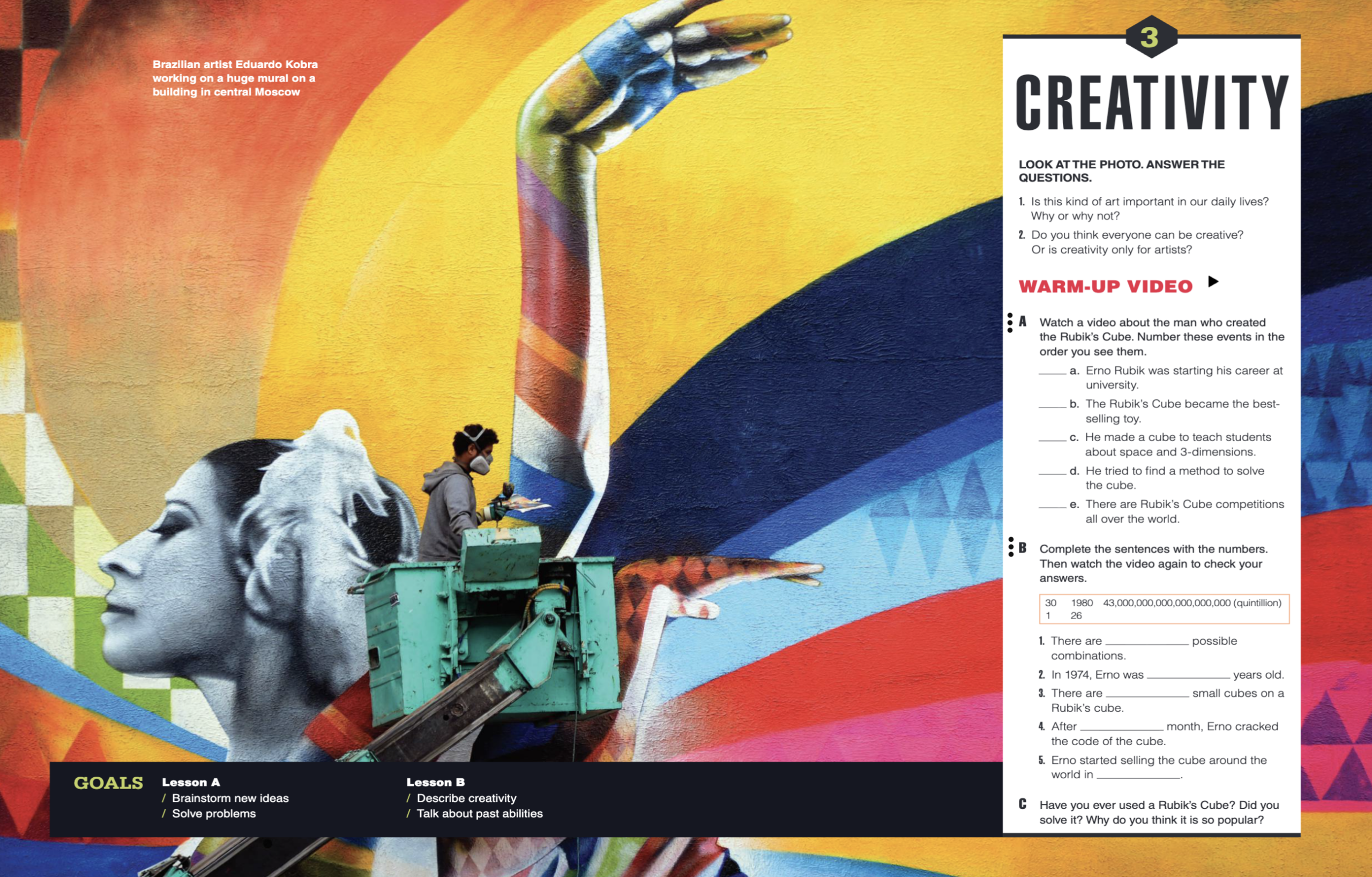
Some skills such as Creativity can provide a great framework for a series of lessons and naturally generate a range of lexical sets. Similarly, certain sub-skills lend themselves to lessons with reading texts followed by discussion.
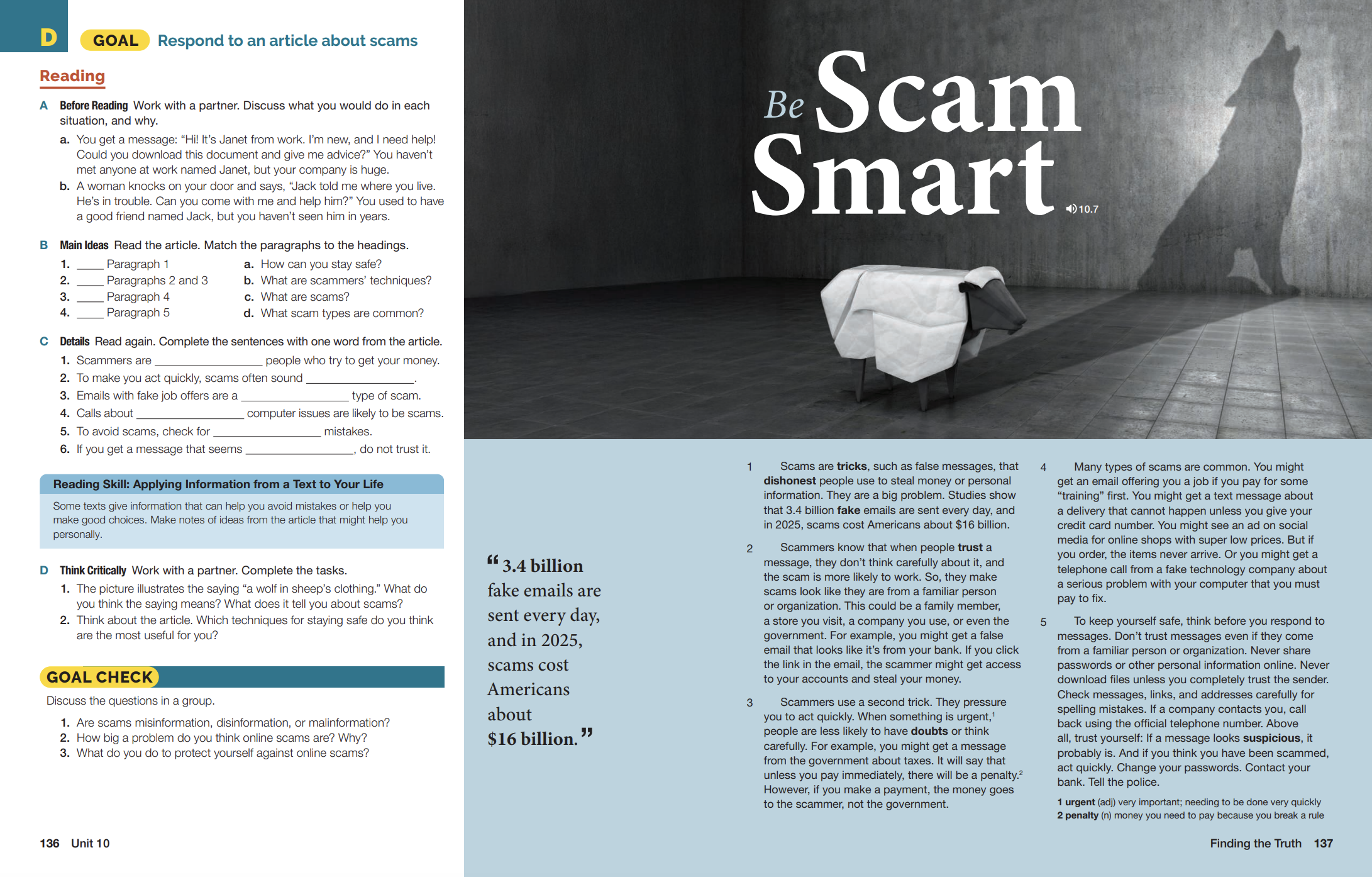
For example, the forthcoming new edition of World English contains a reading text with discussion questions on being ‘Scam Smart’ which is a subskill of digital literacy. Learning to evaluate online information critically is also something students will need when making decisions at work and in everyday life.
Teach learners to do the skill
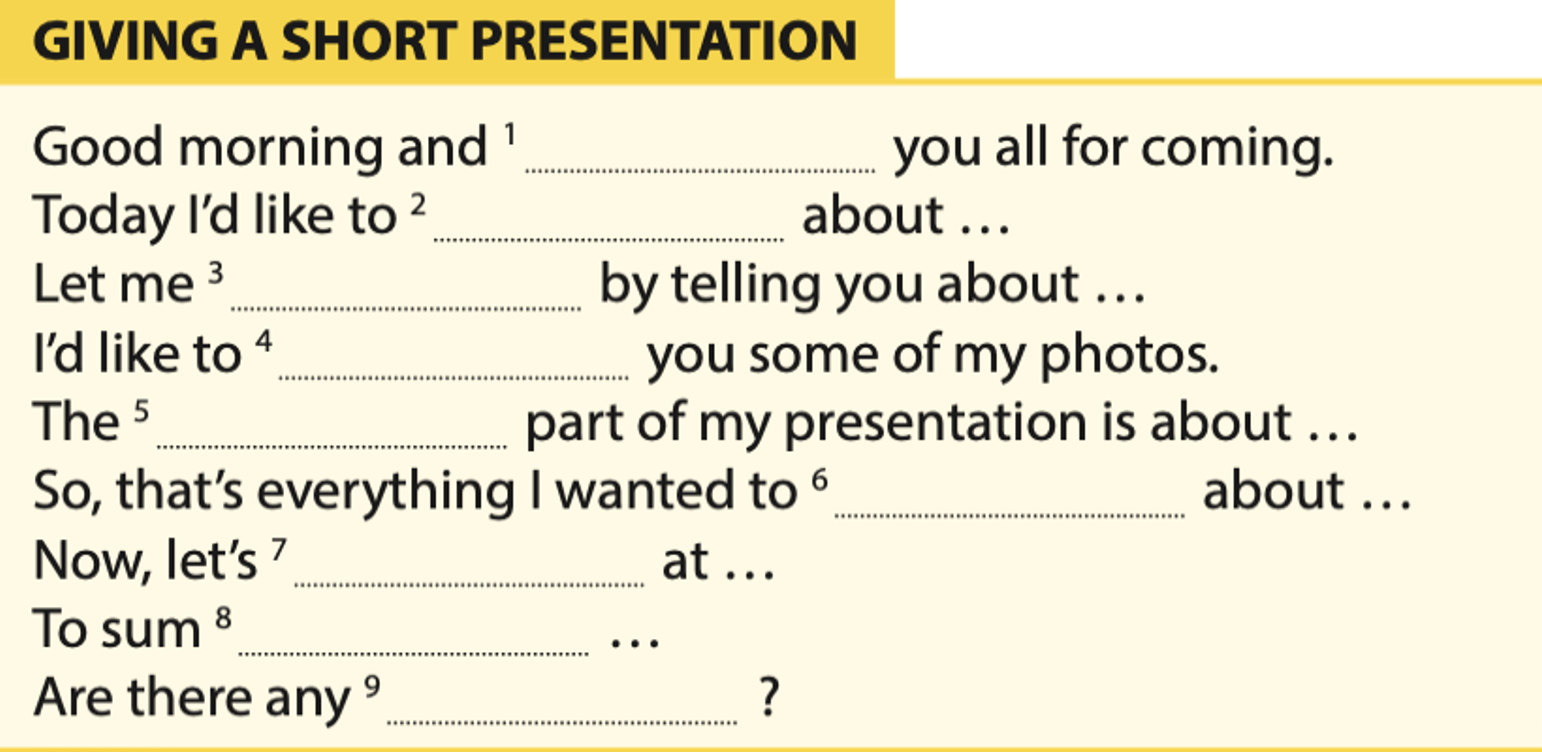
As well as making your lesson ‘about’ a skill, English language teachers also need to consider what language students will need to ‘do’ the skill; in other words, our starting to point is to ask whether the future-ready skill requires certain high frequency language. An obvious example would be Presentation Skills. Students need to develop this key communication skill for their future working lives. They may need to present an idea, explain a recommendation, or update colleagues on a project.
Fortunately, this skill can be supported with a set of phrases to provide a basic structure, like this list below from Life, Third Edition. In the lesson, students listen to a presentation which includes the phrases below, they write in the missing words, and then they use these in their own presentations to the class.
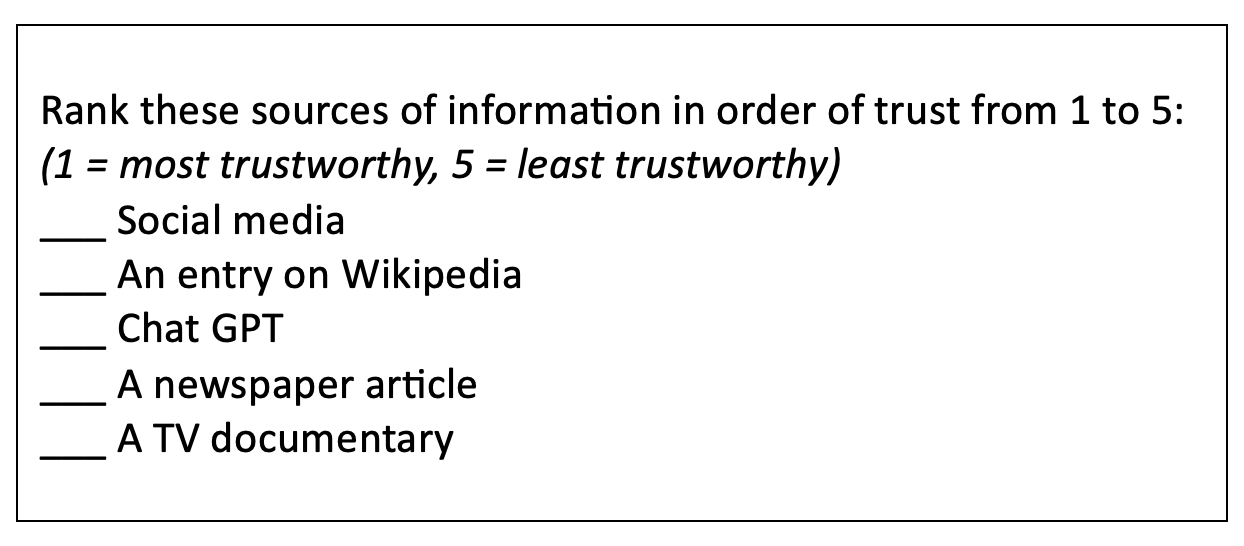
Of course, not all skills come with a naturally occurring set of phrases with which we can ‘do’ that skill. Take the skill of AI Literacy. It’s harder to predict the type of language needed to support such a skill but, nonetheless, we can provide learning opportunities which combine language practice and skills development. Here’s an activity (unpublished) I use to draw attention to levels of trustworthiness in different sources of information. Students rank the five sources and then use the language of giving an opinion (I think…/ I disagree that…) and comparative forms (more trustworthy, the least trustworthy…) to discuss the rankings in groups.
Mentor the skill
My third way of approaching the integration of future-ready skills centers on the role and methodology of the teacher. Take Collaboration skills. In ELT lessons we often give the instructions Work in pairs and Work in groups so collaboration forms a natural part of our methodology. But it isn’t enough to put students into groups of three or four and assume they know how to collaborate.
The teacher can also mentor this skill by training students in group organisational skills; for example, when you first start using group work with a class, appoint one student to be the group leader, one to take notes, and one to report back to the class on the group’s decision. These roles mirror the ways teams often share responsibility when working together on projects in the workplace. In this way, the group collaborates more effectively and eventually they will automatically delegate and assume these roles without prompting from you.
Adaptability is another skill which lends itself to mentoring. For me, it’s a skill that benefits from being role modelled by the teacher. A classroom which models adaptability is one where a teacher walks in with clear goals and objectives but is also willing to adapt to the needs of the students on the day. For example, maybe there’s an area of language which emerges in a lesson and needs addressing. The adaptable classroom is one that recognises mistakes are an opportunity for learning or provides space for the students to ask questions and even affect the topic of the lesson. In this type of classroom, students begin to see adaptability as a habit they can apply in situations beyond school.
To sum up…
- Future-ready skills can form a natural part of our English lessons without requiring a separate instructional approach.
- We can use future-ready skills as the topic of a lesson or series of lessons.
- Future-ready skills can help us define the language we teach and have students practice.
- Teachers can mentor the skills, making them part of the classroom methodology and modelling the skills themselves.
Continue the conversation with John
Join John Hughes and other leading voices in education for our Future-Ready Perspectives webinar series. Explore how changing expectations in education and the workplace are reshaping the skills learners need—and what this means for English language teaching today.