

The job market our students are preparing to enter looks very different from the one most of us entered ourselves. Artificial intelligence, global collaboration, digital transformation, and ever-changing career pathways are reshaping the skills people need to thrive. While subject knowledge remains important, employers increasingly value more than just technical expertise. During my talks at the National Geographic Learning Experience Brazil in May 2026, educators were invited to reflect on their own experiences as students back in the day, as well as the ones they had when they entered the job market, and consider how things could have been different if their learning experiences had better prepared them for the world they were about to encounter.
When we think about it, preparing students for the future is no longer just about teaching content. It is about helping them develop the competencies needed to navigate uncertainty, work with others, and continue learning throughout their lives. And that starts with future-ready educators — with us. That’s why we need to find the best tools to develop these skills ourselves so we can help learners become better prepared, too.
What the Research Says
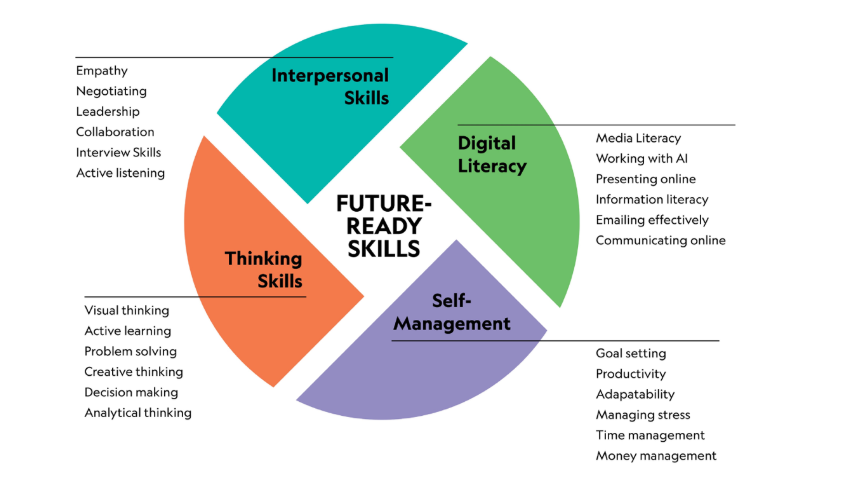
Research into workforce trends — including the research recently conducted by the editorial team at National Geographic Learning — consistently highlights a set of essential future-ready skills. These include communication, creativity, adaptability, collaboration, leadership, critical thinking, problem-solving, emotional intelligence, digital literacy, resilience, time management, and active learning. And the numbers say it all: 39% of employees’ skills will become outdated within five years; 86% of employers expect AI to transform their businesses; and AI is expected to create 11 million jobs while displacing 9 million.
While these figures can be daunting, they also show us how fast the environment is changing. During the NGL Experience presentations, teachers confirmed these trends and shared examples from their own classrooms and lives.
Bringing Future-Ready Skills to Your Classroom
The skills mentioned above are not tied to a single profession or industry. They are transferable competencies that enable individuals to succeed across different contexts and careers — and that’s the beauty of it! The greatest challenge for educators is that these skills cannot be developed through traditional instruction alone; students do not learn collaboration by reading about teamwork, nor do they develop resilience through multiple-choice tests. Future-ready skills require meaningful experiences, reflection, inquiry, and opportunities to apply learning in authentic situations. The English classroom is the ideal ecosystem for learners to develop future-ready skills and with the bonus of doing so in English. For example:
- Practicing the development of interpersonal skills, such as collaboration and active listening, as they role-play a job interview is a realistic example of what can take place in the classroom.
- Developing self-management, as learners work on better ways to manage their time and their emotions. This example was shared as a first-hand experience by one of the teachers attending the NGL Experience talk.
This means educators must rethink the role of the classroom. Rather than focusing exclusively on knowledge transmission, teachers are increasingly becoming facilitators of learning experiences that encourage communication, creativity, and critical thinking. Project-based learning, collaborative tasks, problem-solving activities, and real-world challenges can help students develop the competencies demanded by today’s workplaces. Yes, the future is closer than we can imagine…
Why Future-Ready Educators Matter
Creating the learning experience I just mentioned requires teachers to embrace their own professional growth. Future-ready educators are lifelong learners. They remain curious about emerging technologies, explore new teaching approaches, engage with global issues, and reflect on how learning connects to students’ lives beyond school. They understand that education is not simply preparation for exams; it is preparation for participation in an increasingly complex and interconnected world.
Digital literacy provides a clear example. Students need to evaluate online information, communicate effectively through digital platforms, and use technology responsibly. To guide learners in these areas, teachers themselves must feel confident navigating digital environments and integrating technology purposefully into their practice. The goal is not to use technology for its own sake, but to help students become thoughtful and responsible digital citizens. Bringing content to class that helps learners analyze and evaluate data in order to make more informed decisions and think more critically (in and out of the classroom) is one of the ways we can teach data literacy.
Perhaps most importantly, future-ready educators model the very skills they hope to develop in their students. When teachers demonstrate adaptability, collaboration, empathy, and a willingness to learn, they create classroom cultures where those qualities can flourish. Students learn not only from what educators teach but also from how educators approach challenges, solve problems, and engage with the world around them.
Reflecting on Future Readiness
The future remains unpredictable. New industries will emerge, technologies will evolve, and workplace demands will continue to shift. While we cannot prepare students for every specific challenge they will encounter, we can equip them with the skills and mindsets needed to adapt and succeed. Before I wrap up, I’d like to invite you to reflect upon the following questions:
- What challenges are my learners likely to face in their future studies, careers, or communities?
- Do my classroom activities mirror the kinds of situations students will encounter beyond school?
Future-ready students need future-ready educators because the best way to prepare learners for tomorrow is to ensure that teachers are continuously learning today and always.
Bring future-ready skills to your classroom
Download our paper for classroom-ready strategies to integrate future-ready skills into your English curriculum.