


Why grades often hide learning
Picture this classroom moment.
The teacher hands back last week’s quizzes. Students glance at their papers and immediately begin asking each other:
“What did you get?”
“Was it hard?”
“I got an eight. What about you?”
Soon they are standing up and comparing grades.
For many students and parents, this number—the grade—has become the main way of “seeing” learning. But what if that number actually hides more than it reveals?
Traditionally, students of English as an Additional Language (EAL) in primary, secondary, and higher education—and often their parents as well—have become accustomed to visualizing learning through grades assigned to assessment tasks such as:
- written or oral exams
- pieces of writing
- presentations
- worksheets
- posters
- projects
These grades are typically averaged to produce a final grade for a learning period. In other cases, points are attributed to each instrument on a 0–10 or 0–100 scale and then added together to calculate the final result.
Even when performance assessments are included, students’ success is still summarized by a single number. For example, if a student goes from a 5 to an 8 from one grading period to another, we might assume that the student has clearly progressed in learning the intended outcomes.
It cannot be more objective than this, right?
Not necessarily.
Grades produced through adding or averaging results from different assessment tasks often create an illusion of objectivity. This approach could be described as instrument-based assessment, because the final grade reflects performance on different instruments rather than mastery of specific learning outcomes.
Historically, grading systems were designed to summarize learning efficiently. However, while they offer a convenient snapshot of performance, they often obscure the specific learning that has taken place.
This illusion of objectivity exists for several reasons:
- When we average scores from instruments that measure different learning outcomes—such as writing tasks, quizzes, exams, presentations, and projects—we lose sight of which outcomes a student has actually achieved. We may know that a student is above or below the average, but what exactly are that student’s strengths and weaknesses? Are two students with the same final grade truly comparable?
- Research shows that grading practices vary considerably among teachers and even within the practices of the same teacher (Guskey & Brookhart, 2019). Grades can differ across terms, across different groups at the same level, or even within the same group of students.
- Teachers may assign grades for completing homework, participating in class, submitting work on time, or following classroom procedures. When these behaviors are combined with academic performance in a single score, it becomes unclear what the grade represents.
- This assessment system rarely makes clear to students what they actually need to improve. Two students who receive the same result on a test may have struggled with entirely different aspects of learning.
- When learning is reported through a single grade, students’ and parents’ attention tends to focus on the number itself rather than on the learning that did—or did not—take place. The number becomes the focal point because that is what their eyes and minds have been trained to look for.
As a teacher, you’ve probably encountered one or more of the challenges above with your assessment system. If grades based on instruments obscure learning, the question becomes: what should assessment focus on instead?
Outcomes-based assessment: making learning visible
Outcomes-based assessment approaches the issue from the opposite direction.
In this model, teachers begin by defining clear learning outcomes. Instructional activities are designed to help students achieve those outcomes, and evidence is collected to determine whether they have done so.
We might still use familiar assessment instruments, such as quizzes, presentations, or written tasks. However, their role changes. Instead of contributing to a single score, they provide evidence of whether students achieved specific outcomes.
Ideally, as teachers, we gather an additional source of evidence often overlooked in traditional grading systems: structured observations of students’ interactions in class.
With this evidence in hand, we can assess whether students have achieved each outcome and to what extent.
Achievement can be described using criteria such as:
- Fully achieved
- Satisfactorily achieved (the minimum requirement)
- Not achieved yet
- Not enough evidence
For example, instead of receiving an “8 out of 10” on a quiz, a student might receive feedback such as:
| The student is able to… | Not enough evidence | Not yet | Satisfactorily achieved | Fully achieved |
| ✔ |
We can still use quizzes to verify learning, but we use them to look for evidence of achieving specific learning outcomes, and not as an overall measurement of success. With performance-based types of assessments, such as projects, we can evaluate different skills students used to produce their work, as this example from the coursebook Impact shows:
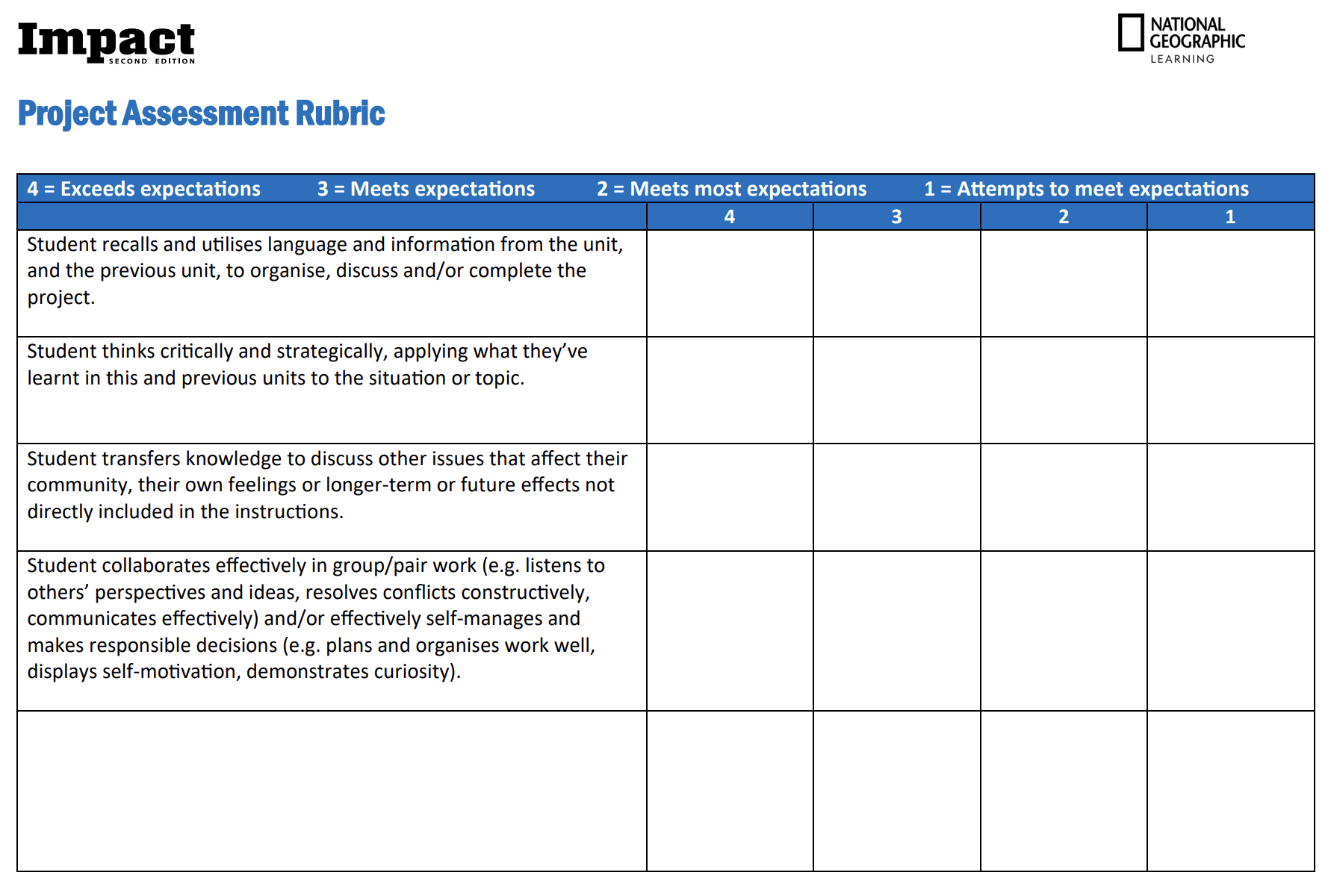
The language used in the criteria can vary, but it’s best to refrain from using words that express judgment, such as “excellent”, “good”, “average”, and “fair”.
This is why an outcomes-based assessment approach makes learning visible and benefits teachers and students:
- It focuses on what students learned rather than on the instrument used to verify learning. We might still use tests, but we tie the results to specific outcomes rather than summarizing them as a single score.
- It prevents non-cognitive behaviors from distorting academic achievement. We can still report behaviors such as class participation or completing homework, but separately.
- It encourages teachers to focus on what our students can do rather than on what they cannot do. The teacher’s role becomes one of searching for evidence of achievement rather than evidence of failure. Here is an example of how can-do statements can be used to demonstrate the learning outcomes of projects with young learners:

- It supports differentiated assessment. Once our students demonstrate that they have achieved an outcome, we can focus on learners whose evidence of learning still needs to be verified while also providing more advanced challenges for those who have already succeeded.
- It provides clear and actionable feedback. Students can see where they are in relation to each outcome and what they need to do to improve.
- It aligns with a growth mindset toward learning and mirrors real-world workplace evaluations, which are often competency-based rather than grade-based.
With this approach, students may still take quizzes, but they will not receive a single grade. Instead, they will be assessed on the outcomes those quizzes address.
Gradually, students’ conversations among themselves and with parents may begin to shift:
“Which outcomes did you feel confident about?”
“Which do you want to get better at?”
When assessment shifts from scores to evidence, learning stops being hidden behind numbers and becomes visible to everyone involved in the learning process.
Reflect and discuss:
Would you say your school uses instrument-based assessment or outcomes-based assessment? Why?
What are some ways you integrate outcomes-based assessment at your school or in your classroom?
Want more tips and real‑world insights from ELT professionals? Subscribe to our global newsletter and stay connected with educators around the world.