

What does success look like for your institution?
While traditionally, exam results have been used to indicate institutional success and competitiveness, we are currently finding ourselves in a world where academic qualifications alone are no longer enough. Top industries are increasingly vocal about the lack of professional skills in applicants. Hiring processes are evolving to filter hundreds of applicants with the same basic qualifications. And the rise of AI is reshaping the way the world works. (1, 2, 3)
With the world going through drastic changes, maintaining a traditional outlook is insufficient. Maybe our institutions produce strong exam results, but if our students are entering the world without essential skills that give them competitiveness in the workplace, have we truly been successful in educating them?
The world of work is transforming, social and international relationships have shifted, and the reality our students face is completely different to the one many of us were prepared for. Many institutions are responding by modernizing curricula, methodologies, or the technologies used in the classroom. But research has shown us that tools alone do not drive better learning — and might even reduce our own human and cognitive abilities. If we want to prepare students for a rapidly-changing world, we need to focus on developing the human competencies that machines cannot replace. (4, 5, 6)
Supporting Teachers: A Solution for Success
It’s important to take a closer look at the most valuable resources we have to bring our institution’s vision to life: our teachers. While technologies and methodologies can support more streamlined processes, it is teachers who create the learning experience — and therefore define student success. (7, 8)
When a school administration focuses solely on standardization, documentation, and exam results, this can inhibit teacher creativity and motivation — the very qualities that motivate students. These qualities influence how teachers develop the next generation not just academically, but holistically also. So how do you ensure teachers are ready and able to develop the skills students need? (9, 10)
Here are some important questions to start with:
- Are your teachers supported in ways that allow for that creativity to develop?
- Does your institution inspire teachers to feel motivated as they enter their classrooms, and to pass that motivation on to students?
- Are your teachers able to incorporate opportunities for meaningful skill development in the classroom?
- We don’t learn new things overnight simply by attending a conference, webinar, or course. How are your teachers supported in putting that learning into practice, and in modeling the continuous development we now expect from students as lifelong learners?
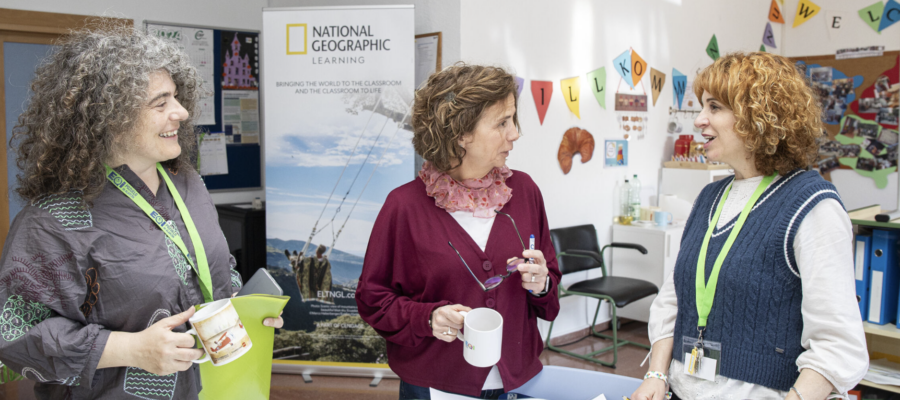
Here are a few strategies for institutions to incorporate simple but deeply effective teacher collaboration spaces, which will enhance your team, their classes, and your institutional success as a whole:
Teacher Circles
Start creating teacher-centered spaces in addition to standard administrative meetings. This allows for dialogue and reflection, opening opportunities for teachers to share classroom experiences, and learn from each other.
Providing these opportunities will build a more united team, working together toward shared institutional goals. Rotate speakers to share a challenge or a positive experience from their classes. Have a few prompts ready to keep the dialogue flowing: Why do you think this worked? Would your students respond similarly? What else could we add to this idea?
This is a non-judgmental space for brainstorming, inspiration, and reflection where ideas and motivation grow, and naturally spread to students.
“While technologies and methodologies can support more streamlined processes, it is teachers who create the learning experience — and therefore define student success.”
Peer Coaching
This approach goes a step deeper. Instead of reflecting on past experiences, teachers collaborate to design future lessons.
Teachers begin by planning lesson objectives, activity choices, and expected results together. After putting it into practice, they come together again to reflect on what actually happened in class. They can discuss what they observed, analyze the lesson sequence, and identify adjustments and improvements for next time.
Reflection becomes shared and dynamic. Teachers help each other consider new ideas and get fresh perspectives from their colleagues.
Read my post on reflective teaching practices for a deeper dive into this topic!
Action Research Cycles
This places professional development in the hands of your teachers, as lifelong learners. Many teachers agree on the value of continuous learning but lack the time to pursue it.
Present teachers with a question to investigate in their classrooms:
- What activities improve student engagement?
- Which types of communication tasks do students feel most comfortable trying?
- How well do students plan project steps, and what support do they need?
After investigating the question in their own classrooms, teachers can come together to share insights.
Here are the steps to try it out:
- Identify a research question
- Collect relevant data (student work, recordings, assessments, rubrics etc.)
- Analyze findings and plan changes for next time
- Implement changes and reflect again on their effectiveness
This turns reflection into structured inquiry, connecting classroom practice with teachers’ own evidence and insights from their real classrooms.
Reflecting on Past Data
Teachers can reflect on past performance data from their classrooms such as:
- Student performance data (test results, rubrics, formative assessment insights etc.)
- Patterns in speaking or writing tasks
- Engagement metrics (e.g., student willingness to participate)
Have teachers ask questions about the data such as:
- What does the evidence suggest about the way students are developing this skill?
- What personal assumptions does the data challenge?
This bases reflection on real outcomes, not teacher perceptions, which can sometimes miss or assume things in the classroom.
For example, when I once taught a differentiated class, I thought my weaker speakers would not be able to catch up in time for their final speaking presentations. But after looking through previous exit tickets, I realized that adding more varied speaking examples could help “fill in the gaps” and boost their confidence.
Past records will always hold a lot of useful data for future decision-making.
Putting It Into Practice
Simpler reflective meetings can take place weekly. Instead of relying on one permanent, rigid lesson plan, help teachers bring their classrooms to life by reflecting on their real-world dynamics. Shared reflection builds community and encourages the kind of “try it out” mentality that individual reflection often doesn’t reach.
Deeper, monthly reflections can allow for a more thorough analysis. This is a chance to debate problems and issues seen in the classroom and plan how to collect data and insights to manage them.
We can also facilitate dialogue on one big theme and discuss how to incorporate it into your programs: differentiation, autonomy, global literacy etc.
A chance to come together each cycle supports growth as a team. This creates shared goals in preparing students for an increasingly challenging future, while positioning the institution as a place where meaningful, competitive skill development thrives.
Conclusion
The most transformative development for an institution is not a new technology, but a sustainable process for your teachers’ development — one that is social, structured and supported. When there is a shared culture of reflection and inquiry, teaching practices evolve in ways that become both meaningful and exciting. This can continuously renew and improve the effectiveness of your team, their classes, and your institution as a whole.
Want more tips and real‑world insights from ELT professionals? Subscribe to our global newsletter and stay connected with educators around the world.

References
- Khanna, B. (2025, September 7). Degree or skills: What matters more in today’s job market? https://www.linkedin.com/pulse/degree-skills-what-matters-more-todays-job-market-bhupendra-khanna-5o1jc/
- Lynn, M., & Lynn, M. (2025, October 27). 5 Ways Higher education is changing in 2025-26. Hanover Research. https://www.hanoverresearch.com/reports-and-briefs/higher-education/5-ways-higher-education-is-changing-in-2025-26/#form
- Fuller, J. B., Raman, M., Accenture, Grads of Life, & Harvard Business School. (2017). Dismissed by degrees [Report]. Accenture, Grads of Life, Harvard Business School. https://www.hbs.edu/managing-the-future-of-work/Documents/dismissed-by-degrees.pdf
- Pinar, A. (2025, July 30). Technology in classrooms and the student brain: impacts on learning, memory, attention, and emotion. https://www.linkedin.com/pulse/technology-classrooms-student-brain-impacts-learning-pinar-fhea-b4jqc/
- Fesler, L., Martinez, J., Claeys, C., Agnew, S., & AI Hub for Education of the SCALE Initiative, Stanford University. (2026). The Evidence Base on AI in K-12: A 2026 review. In AI Hub for Education. https://scale.stanford.edu/sites/default/files/The%20Evidence%20Base%20on%20AI%20in%20K-12%20Report.pdf
- Cooney Horvath, J. (2026, Jan 22). [Written Testimony To The Joint Standing Committee on Education and Cultural Affairs]. Resolve, to Study the Use of Technology in Classrooms and Study Safeguards Related to Its Use. https://www.mainelegislature.org/legis/bills/getTestimonyDoc.asp?id=10059651
- Vitoria, L., Ramli, M., Johar, R., & Mawarpury, M. (2024). Key Influences on Students’ Academic Success: Insights from Scholarly Research. Journal of Educational Management and Learning, 2(1), 9–19. https://doi.org/10.60084/jeml.v2i1.164
- Visible Learning: Hattie’s research on what works. (n.d.). https://www.structural-learning.com/post/visible-learning-a-teachers-guide
- Robinson, K. (2006, June 27). Do schools kill creativity? [Video]. TED Talks. https://www.ted.com/talks/sir_ken_robinson_do_schools_kill_creativity
- Bloom, E., B., & VanSlyke-Briggs, K. (2019). The demise of creativity in tomorrow’s teachers. Journal of Inquiry & Action in Education, 10(2), 90–92. https://files.eric.ed.gov/fulltext/EJ1241564.pdf