


Why preparing students for tomorrow begins with our growth today
For a long time, conversations about the future of education felt somewhat distant — the kind of discussions found in policy reports, conference keynotes, or strategic plans rather than everyday teaching practice. Recently, however, those conversations have moved much closer to the classroom. Artificial intelligence, changing learner expectations, global uncertainty, and evolving career pathways are no longer future scenarios; they are shaping how we teach and learn right now.
For English language educators, this raises an important question: What does it actually mean to be future-ready?
It is tempting to interpret future readiness as learning new technologies or updating methodologies. While those matter, they only tell part of the story. Increasingly, research and international education frameworks suggest that future readiness is less about mastering tools and more about developing holistically: intellectually, professionally, and humanly.
Over time, I have come to see future readiness not as a product, but as a process.
Beyond Skills: Rethinking What “Future-Ready” Means
Global education discussions increasingly emphasize that thriving in uncertain contexts requires a combination of knowledge, skills, attitudes, and values. The OECD’s Future of Education and Skills 2030 project argues that education systems must support learners and educators in developing agency, adaptability, and ethical awareness, not just technical competence.
English classrooms have always been spaces where communication, culture, and identity intersect. In many ways, ELT has been preparing learners for global interaction long before “21st-century skills” became a policy term. What is changing now is the scale and speed at which adaptability is required.
Future readiness therefore asks educators to move beyond a narrow focus on methodology toward broader professional growth. It is about understanding global change, fostering critical thinking, supporting learner agency, and navigating complexity alongside students.
In other words, teaching English today increasingly means helping learners make sense of the world – not just its language.
The Expanding Role of the Educator
Teachers are no longer seen solely as curriculum deliverers but as agents of change, expected to integrate digital learning, well-being, and interdisciplinary thinking into their practice.
This expansion can feel overwhelming. Many educators already carry heavy workloads, and adding “future readiness” to the list may sound like yet another expectation. However, future readiness is not about doing more. It is about developing differently.
It involves strengthening three interconnected dimensions:
| Pedagogical adaptability | Professional identity | Human competencies |
| Responding to new learning environments | Understanding one’s role in a changing profession | Empathy, collaboration, and reflective thinking |
Interestingly, research consistently shows that these human competencies remain uniquely central to teaching, even as AI advances. Technology may assist instruction, but human educators continue to provide the relational and emotional dimensions that learners value most.
Digital Competence Without Losing the Human Core
Technology is often presented as the defining feature of future education. UNESCO’s ICT Competency Framework for Teachers identifies digital literacy as essential, encouraging educators to integrate technology meaningfully into pedagogy, assessment, and professional development.
Future-ready educators ask questions such as:
- Does this technology deepen learning or just accelerate tasks?
- Does it promote agency or dependency?
- Does it create connection or distraction?
The challenge is not adopting technology quickly, but adopting it thoughtfully.
In language education especially, where communication and interaction are central, technology should amplify human exchange rather than replace it.
Holistic Professional Growth: Learning Beyond Methodology
A growing body of research connects future readiness with holistic teacher development; including global competence, sustainability awareness, and interdisciplinary thinking (Listopadzka et al, 2025).
Early in our careers, professional growth often focuses on techniques: classroom management, lesson planning, assessment strategies. Later, development becomes broader and more reflective:
- understanding learners’ social realities,
- engaging with global issues,
- connecting education to purpose and impact.
Education must help individuals navigate uncertainty ethically and collaboratively, not simply acquire transferable skills.
For educators, this means professional development may increasingly include experiences outside traditional training:
- interdisciplinary conferences,
- cross-cultural collaboration,
- reflective communities of practice,
- engagement with research beyond ELT.
Future readiness grows at the intersection of education and life experience.
Read my recent post for tips to make the most of conferences and events as an educator!
Preparing Learners for a Changing World
Current skills research highlights that adaptability, creativity, collaboration, and problem-solving underpin success across changing labor markets (OECD).
Language classrooms are uniquely positioned to cultivate these abilities. Every communicative task already involves negotiation of meaning, perspective-taking, cultural awareness, and real-time problem solving.
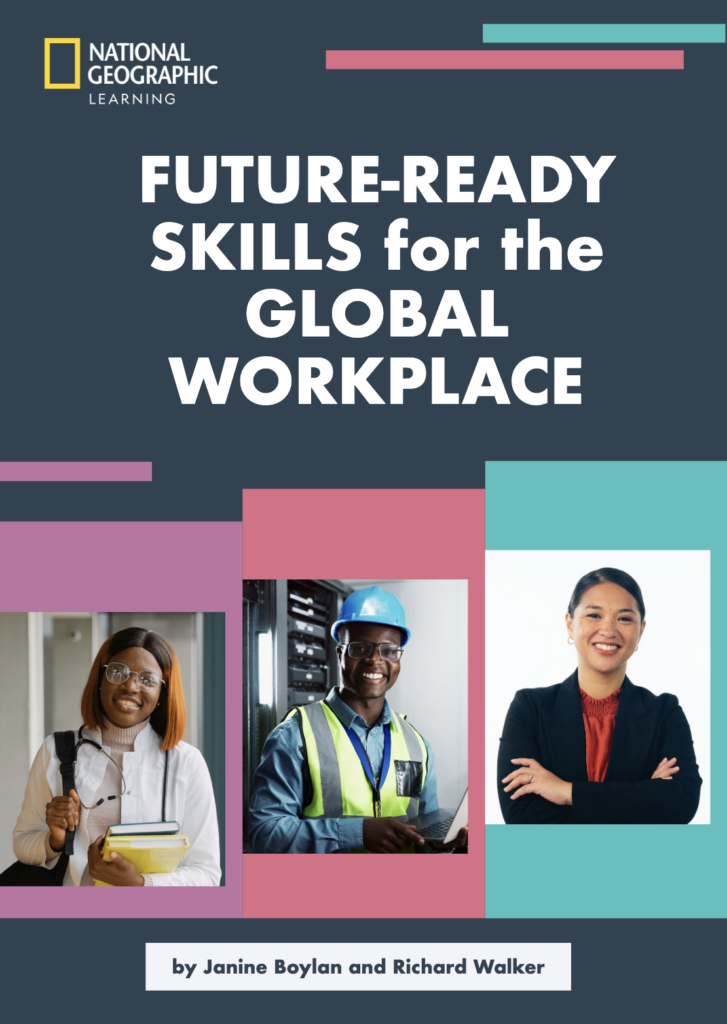
When educators consciously frame activities around these broader competencies, language learning becomes preparation for participation in complex global environments. This paper from National Geographic Learning, ‘Future-Ready Skills for the Global Workplace’, highlights strategies to integrate future-ready skills through practical classroom activities.
Future readiness does not require reinventing ELT. It requires recognizing the deeper value of what we already do, and making it more intentional.
Future Readiness Starts with Teacher Agency
One of the most powerful ideas emerging from global education frameworks is teacher agency — the idea that educators are not passive recipients of change but active shapers of it.
Education systems evolve most effectively when teachers participate in designing and interpreting change rather than merely implementing reforms. To be future ready, educators should experiment responsibly, reflect critically, share practices openly, and contribute to professional conversations.
Future readiness is collective. It grows through dialogue, collaboration, and professional communities.
Your Turn:
Future readiness does not require dramatic transformation. Often, it begins with small shifts in perspective and practice.
✔ Expand what counts as professional development
Read beyond ELT. Explore education, technology, psychology, or global trends.
✔ Develop digital curiosity, not digital pressure
Experiment with tools slowly and intentionally. Ask how they support learning, not just efficiency.
✔ Build reflective habits
After teaching, ask: What did students learn and what did I learn?
✔ Strengthen professional networks
Future readiness grows through conversations with educators from different contexts.
✔ Connect language learning to real-world issues
Invite learners to discuss global challenges, cultural perspectives, and emerging ideas.
✔ Protect the human dimension of teaching
In an age of automation, empathy, presence, and dialogue become even more valuable.
Looking Ahead
Education will continue to evolve in ways we cannot fully predict. New technologies will emerge, learner expectations will shift, and professional roles will expand.
But one idea remains consistent across research and experience alike: education’s future depends less on tools and more on people. Future-ready educators are not those who anticipate every change. They are those who remain curious, reflective, and open to learning alongside their students.
Perhaps future readiness, then, is not about preparing for a specific future at all… but about developing the capacity to grow, adapt, and remain meaningfully human in whatever future arrives next.
Bring future-ready skills to your classroom
Download our paper for classroom-ready strategies to integrate future-ready skills into your English curriculum.
References
Listopadzka, E., Klepacka-Dunajko, I., & Prokopowicz, D. (2025). Teachers as architects of green readiness: Future-ready competencies in education. Procedia Computer Science, 270, 928–936. https://doi.org/10.1016/j.procs.2025.09.213
Organisation for Economic Co-operation and Development. (n.d.). Education and skills policy programmes. OECD. https://www.oecd.org/en/about/programmes/education-and-skills-policy-programmes.html
United Nations Educational, Scientific and Cultural Organization. (2023). ICT competency framework for teachers. UNESCO. https://www.unesco.org/en/digital-competencies-skills/ict-cft


Interesting insights on future readiness for English language educators. Preparing students with communication, collaboration, and critical thinking skills is just as important as teaching language itself in today’s global world.
see